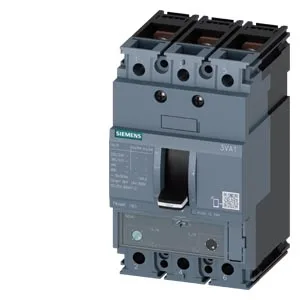
What this MCCB is and what it handles
The Siemens 3VA1116-6EF32-0JC0 is a SENTRON molded case circuit breaker — a 3-pole, 160 A line-protection device with a TM240 thermal-magnetic overcurrent release. It's built for main feeder or large branch protection in distribution panels, motor control centers, and industrial switchboards. The headline number here is the interrupting capacity: 220 kA at 240 V, 154 kA at 415 V, 75.6 kA at 440 V, and 17 kA at 690 V. Those are high-fault ratings — means this breaker can clear a dead short on a 2,000 A transformer secondary without welding its contacts or rupturing the case. At 690 V it still holds 17 kA, enough for most 600 V class industrial services. Rated continuous current is 160 A flat from 40 °C to 50 °C ambient. Above that it starts to taper: 153.6 A at 55 °C, 150.4 A at 60 °C, 147.2 A at 65 °C, 144 A at 70 °C. If your enclosure runs hot — say a packed MCC bucket — factor that derate into the load schedule. The TM240 release is fixed, not adjustable, so the trip curve is set at the factory.
Panel fit and auxiliary hardware
The breaker measures 76.2 mm wide, 130 mm tall, 70 mm deep. That width is a standard 3-pole MCCB footprint — drops into a 3-pole lug kit on the same DIN-rail or bolted bus as other SENTRON 3VA frames. IP40 on the front face means it's protected against tools and wires >1 mm, but not against moisture; keep it inside a dry enclosure. It ships with 2 HQ (high-quality) auxiliary switches and a shunt trip (STL) release. The shunt trip lets a remote pushbutton, PLC, or safety relay force the breaker open — common for emergency-stop chains or undervoltage protection schemes. No undervoltage release, no ground-fault module, no communication board on this variant. The auxiliary trip module is order code 3VA9688-0BL32 if you need a spare.
