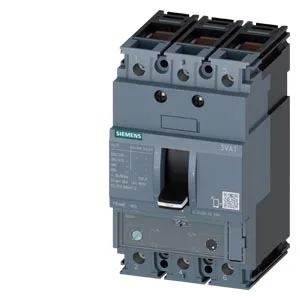
160 A MCCB with 220 kA breaking capacity — selectivity headroom for high-fault panels
The Siemens SENTRON 3VA1116-6EF36-0AC0 is a 3-pole molded case circuit breaker (MCCB) rated 160 A continuous at 40 °C, carrying a TM240 thermal-magnetic release that handles overload and short-circuit protection in one device. Its interrupting capacity hits 220 kA at 240 V AC and 154 kA at 415 V AC — figures that place it in the high-breaking class for main feeders where upstream fault current can exceed 100 kA. Panel builders will note the 76.2 mm width matches the standard 3-pole MCCB footprint for SENTRON; the 130 mm height and 70 mm depth fit common distribution board cutouts.
Above that, derating is gradual: 158 A at 55 °C, 155 A at 60 °C, 153 A at 65 °C, and 150 A at 70 °C (–). For a panel running at 50 °C inside — typical for a non-ventilated enclosure with transformer heat — this breaker delivers its full nameplate. At 70 °C, you lose 10 A, which is still usable for a 150 A continuous load. The TM240 release is fixed-thermal, not adjustable; the magnetic pickup is factory-set to a multiple of the thermal rating, so coordination studies should reference the trip curve for the 240 A frame.
Integration notes for panel builders
The auxiliary switch block — 2 HQ switches — is factory-fitted; no field assembly required. The trip indicator is absent, so remote status comes only through the auxiliary contacts.