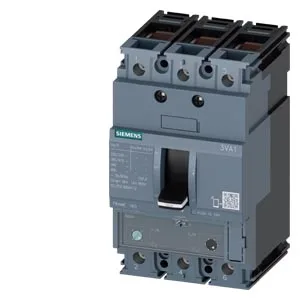
Breaking capacity is 220 kA at 240 V, 154 kA at 415 V, 75.6 kA at 440 V, and 17 kA at 690 V — per the datasheet, these are the maximum fault currents the breaker can safely interrupt at each voltage level. For a 480 V panel fed from a transformer with a 65 kA available fault current, the 75.6 kA at 440 V rating (the closest published point) indicates adequate margin; the 690 V figure of 17 kA confirms this is not a primary choice for 600 V class systems with high fault current. The 3-pole configuration with 2 auxiliary switches (HQ type) and an integrated shunt trip (STL) means it can be remotely tripped via a control signal — useful for emergency-stop circuits or supervisory shutdown sequences.
Above 50 °C the continuous current must be reduced: 153.6 A at 55 °C, 150.4 A at 60 °C, 147.2 A at 65 °C, and 144 A at 70 °C. If the panel ambient runs at 60 °C, the breaker is good for 150.4 A continuous — roughly a 6 % reduction from the nameplate.
The 76.2 mm width (3 inches) is standard for a 3-pole MCCB in this frame size — it occupies three 25 mm (1 inch) pole positions on a DIN rail or panel-mount base.