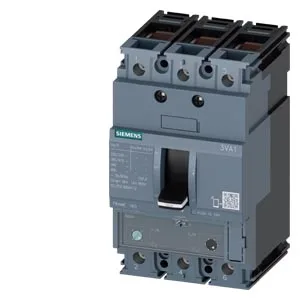
The 3VA1116-6EF36-0KC0 is a Siemens SENTRON 3-pole molded case circuit breaker rated for 160 A continuous current at 40 °C ambient, with a thermal derating curve that drops to 150 A at 70 °C. That 160 A figure is the one you size your feeder conductors to — it holds flat from 40 °C through 50 °C, so you get full ampacity in a warm enclosure without oversizing the breaker. The breaking capacity of 220 kA at 240 V AC means this breaker can safely interrupt a fault current up to that level without welding its contacts or venting plasma into the panel — that is a high-interrupting rating for a 160 A frame, suited for transformer-secondaries or bus-riser positions where available fault current is severe. The shunt trip lets a remote signal — E-stop, fire alarm, or PLC output — trip the breaker electrically without a person pulling the handle. The two auxiliary switches give you normally-open and normally-closed contacts for status feedback to a controller or a panel lamp. Rated insulation voltage is 800 V, which covers 480 V and 600 V class systems with margin.
The breaker measures 76.2 mm wide (3 inches), 130 mm tall, and 70 mm deep. That 76.2 mm width is the standard 3-pole MCCB footprint for this frame size — it fits the mounting base and bus-bar spacing in SENTRON distribution panels and most third-party enclosures designed for IEC molded-case breakers. The 70 mm depth leaves clearance for rear-connected bus bars or a panel-mounting plate without forcing a deeper enclosure than necessary.
The high breaking capacity at 240 V (220 kA) and 415 V (154 kA) means it can serve as a main breaker in a panel fed from a transformer with high fault current, leaving downstream breakers to handle branch faults within their own ratings. At 690 V the breaking capacity drops to 17 kA, so for 690 V systems verify the available fault current stays under that threshold.