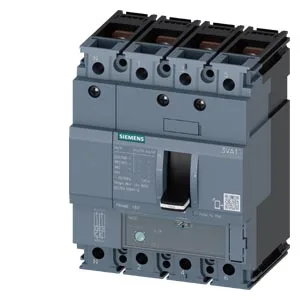
At 415 V the rating is still 154 kA, and it holds 75.6 kA at 440 V, so it handles industrial mains-level faults across common low-voltage networks. The 160 A rating is flat from 40 °C to 50 °C ambient; it derates to 158 A at 55 °C, 155 A at 60 °C, 153 A at 65 °C, and 150 A at 70 °C. That means in a warm panel — say 50 °C internal — you still get full 160 A. Above that, the derating curve is linear enough to plan around if your enclosure runs hot. Dimensions are 130 mm height, 101.6 mm width, 70 mm depth, which fits the standard 3VA mounting footprint.
The TM220 designation means a thermal-magnetic release with a fixed thermal pickup at 1.0× In (160 A) and a magnetic short-circuit pickup at 10× In (1600 A). This is a line-protection design — not a motor-protection breaker with adjustable overloads. It is sized for cable and busbar protection in distribution panels, not for direct motor starting duty where you would need an adjustable electronic trip or a motor-protection circuit breaker.
The 101.6 mm width (4 inches) occupies four 25 mm pole spaces — typical for a 4-pole MCCB in a distribution board. Depth of 70 mm leaves clearance for rear busbar connections in most enclosures. Verify that your panel wiring scheme does not rely on a UVR or remote trip that this unit does not carry.