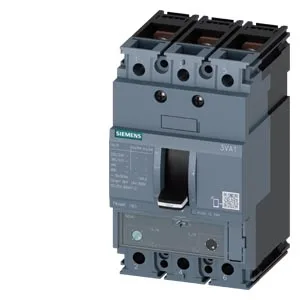
Line protection MCCB with integrated undervoltage release
The Siemens SENTRON 3VA1120-3EF32-0CC0 is a 3-pole molded case circuit breaker (MCCB) rated for line protection, carrying a continuous current Iu of 20 A at 40 °C through 50 °C, with a TM240 thermal-magnetic overcurrent release. Its interrupting capacity reaches 75.6 kA at 240 V AC, 52.5 kA at 415 V AC, 32 kA at 440 V AC, and 10.5 kA at 690 V AC — figures that govern fault-clearing capability in distribution panels where the available fault current is known.
Rated continuous current holds at 20 A from 40 °C to 50 °C ambient, then derates to 19.2 A at 55 °C, 18.8 A at 60 °C, 18.4 A at 65 °C, and 18 A at 70 °C — a linear drop of roughly 0.4 A per 5 °C step above 50 °C that must be factored into panel thermal calculations. Dimensions are 130 mm height, 76.2 mm width, 70 mm depth, with IP40 protection on the front — fits standard SENTRON mounting footprints and panel cutouts for 3VA frame sizes. Mechanical endurance 15,000 cycles.
What the interrupting ratings mean for coordination
The 75.6 kA at 240 V and 52.5 kA at 415 V are the maximum fault currents this MCCB can safely interrupt at those voltages — critical for selectivity studies where the upstream breaker must have a higher or equal interrupting rating to avoid cascading failure.