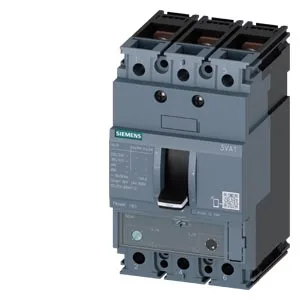
Three-pole, rated 20 A continuously at 40 °C — and it holds that rating all the way up to 55 °C before derating to 19 A at 60 °C and above. Breaking capacity is the headline here: 75.6 kA at 240 V, 52.5 kA at 415 V, 32 kA at 440 V, and 11.9 kA at both 500 V and 690 V. That's a high-interrupting rating for a 20 A frame — it clears severe fault currents without cascading upstream, which simplifies selective coordination studies. The shunt trip lets a remote signal — from a safety relay, PLC, or E-stop circuit — open the breaker under load.
That's a 3-inch-wide footprint — standard for a 3-pole SENTRON 3VA1 frame. Power loss at full rated current is 12 W maximum. In a sealed, uncooled enclosure that heat adds up — account for it in the thermal budget alongside adjacent devices.
What the auxiliary switch block means for the controls engineer
The aux switches mirror the main contact position (open/closed). The trip alarm switch changes state only when the breaker trips on fault — it stays put during manual switching, so a control system can distinguish a maintenance open from a fault event. That's the HQ designation: a separate, latched indication that the breaker cleared a short circuit or overload. The shunt trip (STL) is a separate release coil that opens the breaker when energized. It draws momentarily — not rated for continuous energization.