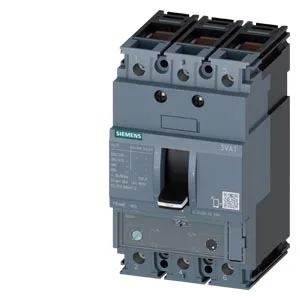
Breaking capacity is the key selection parameter here: 75.6 kA at 240 V, 52.5 kA at 415 V, and 32 kA at 440 V. That SCCR headroom means this breaker can sit upstream of smaller branch devices without cascading failure during a fault — a real advantage when coordinating a panel for high-fault utility feeds. For a line-protection role where the load current is known and stable, that's a reliability gain: fewer adjustment points to drift or get mis-set during commissioning.
Mounting and integration into a panel
The 3VA1120-3EF36-0AE0 measures 130 mm high, 76.2 mm wide, and 70 mm deep. That 3-inch width per pole is standard for SENTRON 3VA frames — it fits the same DIN-rail or screw-mount footprint as other 3-pole 3VA breakers, so a panel laid out for a 3VA1110 or 3VA1010 accepts this unit without drilling new holes or re-spacing the bus bars. Maximum power dissipation is 12 W. In a sealed, high-density enclosure, that heat needs to be factored into the thermal budget — especially if the breaker is mounted alongside other heat sources. The operating temperature range is -25 °C to 70 °C, with a derating curve above 55 °C (19 A at 60 °C, 19 A at 65 °C, 19 A at 70 °C). The breaker accepts up to four auxiliary switches (HQ design) for remote status indication.