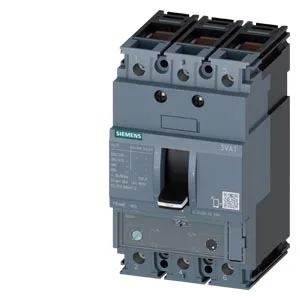
It carries a continuous 20 A rating that holds flat from 40 °C through 55 °C, then derates to 19 A at 60 °C and 65 °C, and stays at 19 A up to 70 °C. That means in a warm cabinet — say, a non-ventilated enclosure near a line reactor — you still get the full 20 A up to 55 °C before any reduction kicks in. At 240 V it interrupts 75.6 kA; at 415 V it handles 52.5 kA; at 440 V it drops to 32 kA; at 500 V and 690 V it holds at 11.9 kA. The overcurrent release is a TM240 — a thermal-magnetic unit with a fixed thermal pickup at 20 A and a magnetic trip that responds to short-circuit currents. There is no undervoltage release, no shunt trip beyond the listed auxiliary release, no ground-fault monitoring module, and no communication function built in. It is a straight line-protection breaker: install it, feed it, and it trips on overcurrent or short.
Dimensions are 130 mm tall, 76.2 mm wide, and 70 mm deep — a standard 3-pole MCCB footprint that drops into a SENTRON panelboard or onto a DIN-rail adapter without reworking the gland plate.