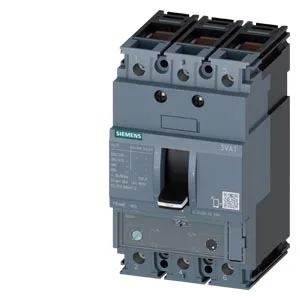
The 20 A rating holds flat from 40 °C up to 50 °C, then derates to 19.2 A at 55 °C, 18.8 A at 60 °C, 18.4 A at 65 °C, and 18 A at 70 °C — so in a warm panel you lose about 10 % of capacity at the top end. The interrupting ratings climb steeply with voltage: 75.6 kA at 240 V, 52.5 kA at 415 V, 32 kA at 440 V, and 10.5 kA at 690 V. That 75.6 kA at 240 V means it can safely clear a fault on a high-capacity 240 V distribution bus without rupturing; the 10.5 kA at 690 V is still adequate for most 690 V motor circuits. It is a straightforward line-protection MCCB for standard distribution panels.
The 3VA1120-3EF36-0JC0 measures 76.2 mm wide, 130 mm high, and 70 mm deep. The 76.2 mm width is a standard 3-pole MCCB footprint for this SENTRON generation — it occupies three 25.4 mm (1-inch) module positions on a DIN rail or panel-mount base. The breaker has a voltage-trigger function (shunt trip) and a latching endurance of 15,000 cycles — adequate for infrequent switching in a distribution role, not for daily motor starting.