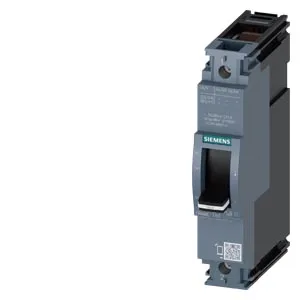
Its 20 A rating holds flat from 40 °C through 55 °C, only stepping to 19 A at 60 °C and above — so in a typical 40 °C panel environment you get the full 20 A without derating. That 9 kA interrupting capacity at 415 V AC is the number that governs fault clearance on a 400 V three-phase line; the 75.6 kA at 240 V is what you'd see on a single-phase 240 V service, but the 415 V figure is the one that decides whether this breaker clears a bolted fault upstream of a motor branch. The TM210 overcurrent release combines a thermal bimetal for overload protection and a magnetic coil for short-circuit trips — standard thermal-magnetic action, no electronic adjustments. At 25.4 mm wide (1 inch), it occupies a single pole space on the DIN rail, matching the footprint of a standard miniature breaker but with the higher SCCR of a molded-case construction.
Integration — what fits where
The 70 mm depth (2.76 in) and 130 mm height (5.12 in) mean it clears most standard 200 mm deep enclosures with room for wiring gutters. The 4 W maximum power loss is negligible in a populated distribution board, but if you're packing 40 of these in a small cabinet, sum the losses against the enclosure's dissipation rating.
What the 415 V and 125 V ratings tell you
Rated operating voltage is 415 V AC and 125 V DC — the AC figure matches standard three-phase line-to-line voltages in 400 V grids; the DC figure covers control circuits or battery-backed loads at 125 V nominal.