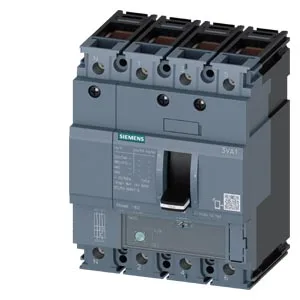
It is a 4-pole unit, meaning it switches and protects all three phases plus neutral in a three-phase four-wire system — common for main incomers or feeder circuits where neutral protection is required.
This MCCB is rated 121 kA at 240 V, 75.6 kA at 415 V, 52.5 kA at 440 V, and 11.9 kA at both 500 V and 690 V. At 415 V — the most common three-phase industrial voltage in IEC markets — 75.6 kA is a high-interrupting rating, suitable for installation close to large transformers or in high-fault-capacity switchboards where downstream breakers need a high upstream SCCR for selectivity.
The breaker holds its full 20 A rating up to 55 °C ambient. At 60 °C it derates to 19 A, and it stays at 19 A through 70 °C.
What the TM220 release means for the installer
The TM220 designation means the thermal element (for overload protection) and the magnetic element (for short-circuit protection) are both fixed, not adjustable. The thermal pickup is calibrated to the 20 A frame rating; the magnetic instantaneous trip is set at the factory. The adjustable response value current (Ii max) is listed at 320 A — that is the maximum magnetic trip setting available on this release variant, not the actual setting, which is fixed. For applications needing field-adjustable overloads or short-circuit pickups, a different release (e.g., an electronic one) would be required.
DC rating and optional accessories
The maximum rated operational voltage for DC circuits is 600 V. The product extension field indicates a motor drive accessory is available as an option — this typically refers to a rotary handle or motor operator for remote or panel-door operation.