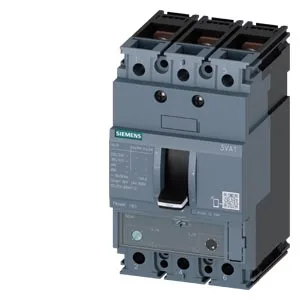
Siemens 3VA1120-4EF32-0AA0 — 20 A MCCB, Line Protection, Current Lifecycle
Its 20 A continuous rating holds across the 40 °C to 55 °C band without derating, then steps to 19 A at 60 °C through 70 °C — useful when the breaker sits near other heat sources in a crowded panel. Interrupting capacity is the headline here: 121 kA at 240 V AC, 75.6 kA at 415 V AC, 52.5 kA at 440 V AC, and 11.9 kA at both 500 V and 690 V AC. The 3-pole format and IP40 front protection suit it for general-purpose panel mounting where the breaker face is behind a closed door.
No official successor has been published for this order code. The 3VA1 series remains Siemens' standard MCCB platform for line protection, so no near-term end-of-life is signaled.
The breaker measures 130 mm high, 76.2 mm wide, and 70 mm deep — a compact 3-pole footprint that fits standard Siemens 3VA1 panel cutouts and busbar systems.
Technical Notes for the Specifier
Maximum power loss is 12 W at rated current — a modest figure that simplifies thermal management in sealed enclosures. For DC applications, the manufacturer directs specifiers to the 3VA molded case circuit breaker device manual for switching power values — the 500 V DC maximum operating voltage is listed, but coordination data for DC networks is handled separately.