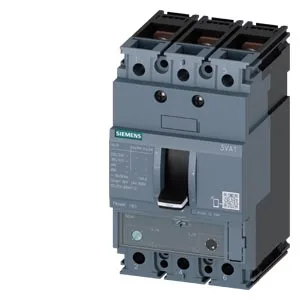
The Siemens 3VA1120-4EF32-0DA0 is a SENTRON molded case circuit breaker (MCCB) designed for line protection in industrial distribution panels. It's a 3-pole unit rated 20 A continuously at 40 °C, with a TM240 thermal-magnetic overcurrent release — meaning the thermal element handles overloads and the magnetic element handles short-circuits up to its interrupting rating. The breaker carries an undervoltage release (UVR) as a built-in auxiliary release, which trips the breaker when supply voltage drops below a set threshold — useful for preventing motor re-acceleration after a power dip.
Breaking capacity and selectivity
Breaking capacity is the headline number for an MCCB — this one delivers 121 kA at 240 V, 75.6 kA at 415 V, and still holds 11.9 kA at 690 V. Those figures tell you it can safely interrupt fault currents up to those levels without welding contacts or venting arc gas into the panel. For a 20 A frame, that's serious headroom; it coordinates well downstream of a larger feeder breaker without needing a current-limiting fuse upstream in most 480 V panels. Insulation voltage is rated 800 V, so the breaker's internal clearances and creepage are designed for 690 V systems with margin. Power loss at rated current is 14.5 W — modest enough that ventilation in a standard enclosure handles it, but worth checking if you're packing multiple breakers in a sealed cabinet.
Dimensions and panel fit
The 3VA1120-4EF32-0DA0 measures 70 mm deep, 76.2 mm wide, and 130 mm tall. That 76.2 mm width (3 inches) is the standard 3-pole MCCB footprint for this frame size — it mounts on a DIN rail or direct panel-mount with the same hole pattern as other SENTRON 3VA1 breakers. If you're swapping out a competitor's 3-pole MCCB in the same current class, check the mounting centers; the depth is shallow enough for most 200 mm deep enclosures.