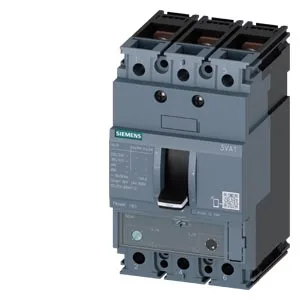
What this MCCB is and what it carries
The Siemens 3VA1120-4EF32-0JA0 is a SENTRON molded case circuit breaker (MCCB) designed for line protection — meaning it sits at the feeder or subfeeder to protect cable and bus against overload and short-circuit, not as a motor-protective device with thermal-bimetal curves tuned for starting inrush. Rated 20 A continuous at 40 °C ambient, it holds that rating through 55 °C and derates to 19 A at 60–70 °C — useful to know if the breaker lands in a warm enclosure or next to other heat sources. Breaking capacity is 121 kA at 240 V AC, 75.6 kA at 415 V, 52.5 kA at 440 V, and 11.9 kA at 500/690 V — the 121 kA figure at 240 V means it can interrupt very high fault currents common on large-transformer secondary or busway taps without upstream coordination changes.
Shunt trip and auxiliary release
This variant ships with a shunt trip (STL) auxiliary release, so it can be remotely tripped by a control signal — emergency-stop circuit, fire-alarm relay, or PLC digital output — without needing a separate undervoltage release module. Rated insulation voltage is 800 V, which covers 480/600 V class panels and leaves headroom for 690 V installations where the breaking capacity still applies.
Panel fit and footprint
At 76.2 mm wide (3 in), 130 mm tall (5.12 in), and 70 mm deep (2.76 in), it occupies a standard three-pole MCCB footprint on a DIN rail or panel-mount base — the depth is shallow enough to clear most gland plates and backpanel wiring troughs. Maximum power loss is 12 W — negligible for thermal budgeting in a ventilated enclosure, but worth noting if the panel is sealed and densely packed.
