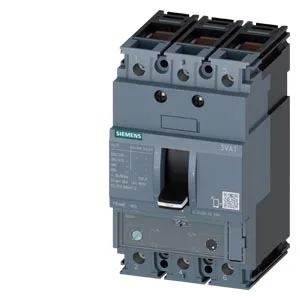
It carries a continuous current of 20 A across an ambient range of 40 °C to 55 °C, derating to 19 A at 60 °C through 70 °C. The interrupting capacity is 121 kA at 240 V AC, stepping down to 75.6 kA at 415 V, 52.5 kA at 440 V, and 11.9 kA at both 500 V and 690 V — the same 11.9 kA figure at 690 V tells you the breaker's internal arc extinction is voltage-limited above that threshold, so coordination studies at higher voltages need that ceiling.
Above 55 °C, you lose 1 A per 5 °C step. That matters if the breaker sits near a transformer or in a non-ventilated enclosure; at 60 °C ambient you still have 19 A of headroom, enough for a 15 A continuous load with margin. The 121 kA interrupting rating at 240 V is the headline number, but the real-world coordination value is at 415 V (75.6 kA) and 440 V (52.5 kA) — common industrial distribution voltages where the available fault current often sits between 50 and 65 kA. The 12 W maximum power loss is low enough that multiple breakers in a row don't drive up the internal panel temperature beyond what the 20 A rating expects.
Built-in accessories and integration
No communication module is fitted, so this is a hardwired-only unit. Dimensions are 70 mm depth, 76.2 mm width, 130 mm height — standard 3-pole MCCB footprint for the SENTRON 3VA platform.
As a SENTRON 3VA series MCCB, this breaker is designed and tested to IEC 60947-2 and UL 489 standards for molded case circuit breakers. The unit carries no ground-fault monitoring or undervoltage release — those are separate accessory variants.