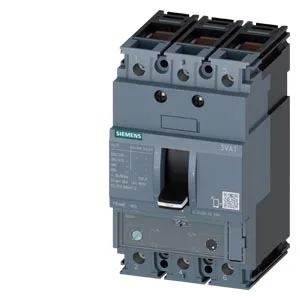
It carries a 20 A continuous rating across the 40 °C to 55 °C ambient range, derating to 19 A at 60 °C through 70 °C — so in a warm enclosure you lose 1 A, not a full trip unit step. The 70 mm depth and 76.2 mm width match the standard 3VA fixed-panel footprint — it bolts into the same mounting pattern as the rest of the 3VA1 family without re-drilling the subplate.
Breaking capacity — the real coordination number
The interrupting rating is what decides whether this breaker coordinates with downstream devices. At 240 V it clears 121 kA; at 415 V that drops to 75.6 kA; at 440 V it's 52.5 kA; and at 500 V / 690 V it holds at 11.9 kA. For a 480 V panel fed by a 1500 kVA transformer, the available fault current typically runs 30–50 kA — this breaker covers that with headroom. At 600 V (common in Canadian and some US industrial plants) the 11.9 kA rating means it's suited for lower-fault locations or where a current-limiting upstream device clips the let-through.
Auxiliary configuration and release
The shunt trip lets a PLC, safety relay, or E-stop circuit open the breaker without a manual visit — common in conveyor interlock and emergency-off schemes.