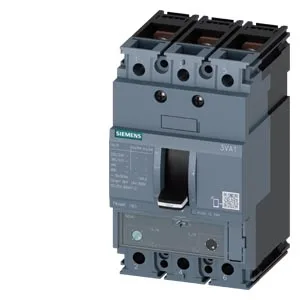
What this MCCB delivers — and what the ratings mean for your panel
The Siemens SENTRON 3VA1120-5EF32-0CC0 is a 3-pole molded case circuit breaker (MCCB) rated for line protection, carrying a continuous current Iu of 20 A at 40 °C through 50 °C. That flat thermal curve means no derating in a typical 50 °C panel interior — a real advantage when the enclosure runs warm. Above 55 °C it steps down: 19.2 A at 55 °C, 18.8 A at 60 °C, 18.4 A at 65 °C, and 18 A at 70 °C. The TM240 overcurrent release handles the thermal-magnetic trip curve for this frame size. Breaking capacity is the headline number here: 187 kA at 240 V, 121 kA at 415 V, 75.6 kA at 440 V, and 17 kA at 690 V. Those are the interrupting ratings at the respective system voltages — critical for fault-current coordination studies. At 415 V, 121 kA covers most industrial secondary-distribution scenarios with high transformer kVA. At 690 V the 17 kA rating is lower, so verify against your available fault current if you're on a 690 V line. Rated insulation voltage Ui is 800 V, so the breaker is insulated for 800 V line-to-line, which covers 690 V systems with margin. IP40 on the front means the face is protected against tools and small wires (1 mm) but not water — standard for a panel-mounted MCCB; the enclosure provides the washdown rating.
Mounting and integration — DIN-rail footprint and panel fill
Dimensions: 70 mm deep, 76.2 mm wide, 130 mm tall. That 76.2 mm width is 3 x 25.4 mm — a standard 3-pole MCCB module pitch, so it fits a 3-module DIN-rail cutout. Depth of 70 mm means it clears a standard 100 mm deep enclosure with room for wiring gutters. The 15,000 mechanical endurance cycles (latching operations) are typical for this class — adequate for a distribution panel that sees infrequent switching; not a contactor duty cycle.
Auxiliary and undervoltage release — what's built in
Comes with 2 HQ auxiliary switches (form C, high-quantity contacts) and an undervoltage release (UVR) as the integrated auxiliary trip. The UVR design means the breaker trips when control voltage drops below a threshold — standard for emergency-stop or undervoltage protection schemes. The auxiliary switches provide status feedback to a PLC or indicator lamp. No trip indicator on the front, no ground-fault monitoring, no communication function, no phase-failure detection — this is a basic line-protection MCCB with UVR and aux contacts.
