What you're looking at
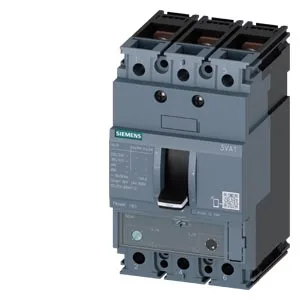
The 3VA1120-5EF32-0CH0: This breaker is built for high-fault environments. At 240 V it interrupts 187 kA, at 415 V it handles 121 kA, at 440 V it's rated 75.6 kA, and at 690 V it still takes 17 kA. That's a serious interrupting capacity for a 20 A frame — it's meant for large transformer secondaries, main feeders, or high-fault panelboards where a standard MCCB would weld its contacts. Mount it inside a panel or enclosure — this isn't a weatherproof standalone device.
Above that, it starts to derate: 19.2 A at 55 °C, 18.8 A at 60 °C, 18.4 A at 65 °C, and 18 A at 70 °C. Mechanical endurance is listed at 15,000 cycles. That's the latching endurance — the number of times you can open and close the breaker under no-load before wear affects the mechanism. For a main breaker that cycles once a day, that's about 41 years. For a motor-disconnect that cycles hourly, it's about 2 years. Plan accordingly.
Auxiliaries and releases
This MCCB comes equipped with an undervoltage release (UVR) — if the supply voltage drops below the release threshold, the breaker trips. That's useful for preventing automatic restart after a brownout or for coordinated shutdown in a safety circuit. That gives you two sets of normally open/normally closed contacts for status feedback — say, one for the PLC input and one for a panel indicator — plus a separate alarm contact that changes state only when the breaker trips on fault, not when manually opened. The integrated auxiliary trip module is order code 3VA9608-0BB24, if you need a replacement or spare. There is no voltage trigger, no communication function, no phase failure detection, and no ground fault monitoring on this variant. It's a straight thermal-magnetic line-protection breaker with undervoltage release. If you need ground fault or phase loss protection, you're looking at a different 3VA variant.
Physical fit
The width of 76.2 mm is roughly 3 inches, so plan your gutter space and wire bending radius accordingly. The trip indicator is present — a mechanical flag on the front shows whether the breaker has tripped on overload or short circuit. Helpful for troubleshooting a line-down situation without needing a meter first.
If you're comparing this to the 3VA1112-5EF32-0CA0 (a 12 A variant) or the 3VA1110-5EE32-0JA0 (a 10 A with different aux config), the physical footprint is the same — same 3-pole frame, same mounting pattern. The difference is the trip unit rating and the auxiliary contact count. This 20 A version with 2 aux + 1 alarm is the one you want for a 20 A feeder with status feedback.