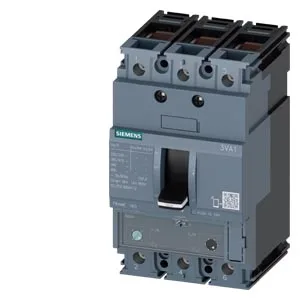
The Siemens SENTRON 3VA1120-5EF36-0HA0 is a 3-pole molded case circuit breaker (MCCB) rated for 20 A continuous current at 40 °C, with a TM240 thermal-magnetic overcurrent release that handles both overload and short-circuit protection in one unit.
Breaking capacity — the real-world short-circuit muscle
This breaker's interrupting rating varies sharply with system voltage: 187 kA at 240 VAC, 121 kA at 415 VAC, 75.6 kA at 440 VAC, and 17 kA at both 500 VAC and 690 VAC.
Temperature derating — don't trust the 20 A label at high ambient
The breaker holds its full 20 A rating from 40 °C up to 55 °C ambient, then derates to 19 A at 60 °C and 65 °C, and 19 A at 70 °C. That matters when sizing for a continuous load near the limit; factor the derating into your wire and breaker coordination.
Dimensions are 130 mm height, 76.2 mm width, 70 mm depth — a standard 3-pole MCCB footprint that fits most DIN-rail or panel-mount enclosures without surprises. The 76.2 mm width (3 inches) is the same as many other 3-pole SENTRON breakers, so swapping in a panel designed for the 3VA1110 series should work without drilling new mounting holes.
What the shunt trip means for your control scheme
The shunt trip (STL) release lets you trip the breaker remotely by applying a control voltage to the release coil. No undervoltage release is fitted here — if you need UVR protection (trip on loss of control power), this is not the variant.