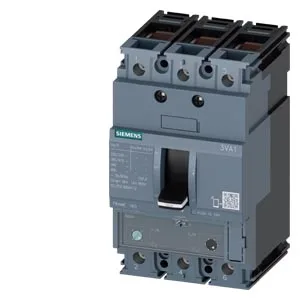
What this MCCB delivers — and what the ratings mean for your panel
The Siemens 3VA1120-5EF36-0JH0 is a SENTRON-series molded case circuit breaker (MCCB) sized for line protection in 3-pole, 20 A circuits. Its headline number is the interrupting capacity: 187 kA at 240 V AC, dropping to 121 kA at 415 V, 75.6 kA at 440 V, and holding at 17 kA at both 500 V and 690 V. That curve tells you the breaker is built for high-fault locations — main distribution boards, transformer secondaries, or industrial feeds where prospective short-circuit current can exceed 100 kA. The 20 A rating holds flat from 40 °C through 55 °C, then derates to 19 A at 60 °C through 70 °C. In a warm enclosure — say 55 °C ambient — you still get the full 20 A; above that, budget the 1 A derate. The 800 V rated insulation voltage and the 12 W maximum power loss are the thermal design constraints: at full load the breaker dissipates about as much heat as a small resistor, so panel ventilation or spacing from heat-sensitive components matters. Operating temperature range is -25 °C to 70 °C; storage range is -40 °C to 80 °C. The auxiliary switch configuration — 2 auxiliary switches plus 1 trip alarm switch (HQ) — and the integrated shunt trip (STL) release give the controls integrator remote status and trip capability without an external undervoltage module (notes undervoltage release is not fitted).
Panel fit and footprint
The 3VA1120-5EF36-0JH0 measures 76.2 mm wide, 130 mm tall, and 70 mm deep. That 76.2 mm width is four 18 mm DIN-module spaces — standard for a 3-pole MCCB with integral auxiliaries. It mounts on DIN rail or can be screw-fixed to a backplate. The depth of 70 mm means it clears most 200 mm deep enclosures with room for wiring gutters. If you are replacing a unit in an existing panel, check the busbar stack height; the supplied basic switch is order code 3VA11205EF360AA0, which is the internal mechanism — the complete breaker ships as the -0JH0 variant with the shunt trip and aux switches pre-installed.
