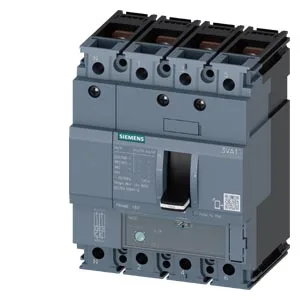
That 20 A holds steady from 40 °C all the way up to 55 °C — it doesn't start derating until 60 °C, where it drops to 19 A, and it holds 19 A through 70 °C. This matters if you're stuffing this breaker into a warm cabinet or a motor control center where ambient heat is a given; you don't lose headroom until the panel is genuinely hot. The interrupting ratings tell the real story for line-side fault coordination: 187 kA at 240 V, 121 kA at 415 V, 75.6 kA at 440 V, and 17 kA at both 500 V and 690 V. For a site electrical engineer working on selective coordination, that's the spec that decides whether the next breaker downstream clears before this one trips. Power loss is 12 W maximum, which is modest for a 4-pole 20 A MCCB and won't cook adjacent components in a dense DIN-rail layout.
The 101.6 mm width (4 inches) is the space you need to budget on the DIN rail — for a panel OEM wireman, that's four inches of rail you can't use for anything else per breaker. Plan your fill factor accordingly. The 4-pole configuration means this breaker switches all three phases plus the neutral. For a commissioning engineer, that's the right choice for a TN-S or TN-C-S system where you want the neutral isolated and protected alongside the line conductors.
For an MRO planner stocking a spare for a line-down scenario, this breaker will sit on a shelf in a non-conditioned warehouse without issue.
What it's for — deployment context
It's not a motor-protective breaker with integrated overload class; it's a distribution MCCB. You'd find it in a main switchboard, a sub-distribution board, or as the incoming breaker in a motor control center bucket. For a field service tech swapping a failed unit, the TM220 trip unit is thermal-magnetic, so no external control power needed — it trips on its own internal mechanism.