At 415 V it still holds 154 kA, and at 440 V it delivers 121 kA; those numbers drop to 17 kA at 500 V and 690 V, so the part is really built for 240–440 V distribution where the SCCR requirement is severe.
Thermal derating and the TM210 release
The TM210 release provides fixed thermal and magnetic pickup — no field-adjustable long-time or short-time bands, which simplifies ordering but means you size it to the load, not tune it. The 20 A rating holds steady from 45 °C up to 55 °C; above that it derates to 19 A at 60 °C, 65 °C, and 70 °C. If your panel ambient runs near 60 °C, factor that 19 A ceiling into the load schedule. The adjustable instantaneous magnetic pickup (li max) goes to 320 A, which is 16× the continuous rating — that keeps the breaker from nuisance-tripping on motor inrush or capacitor charging currents.
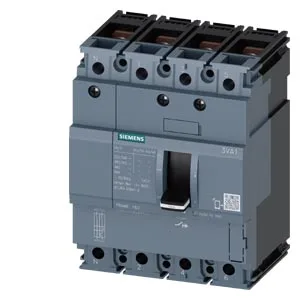
The breaker measures 70 mm deep, 101.6 mm wide, and 130 mm high — a compact 4-pole footprint that fits standard Siemens SENTRON mounting plates and panel cutouts.