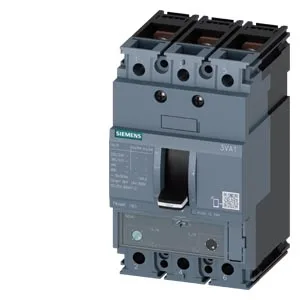
It's a 3-pole unit rated 20 A continuous, and it holds that rating from 40 °C all the way up to 55 °C before it starts to derate; at 60 °C it's still good for 19 A, and at 70 °C it's 19 A. That thermal stability matters out here in the grease where panel ambient temps climb in summer. Breaking capacity is the headline number on this one: 220 kA at 240 VAC, 154 kA at 415 VAC, 121 kA at 440 VAC, and it still holds 17 kA at 690 VAC. That's a high-interrupting rating for a 20 A frame — it'll clear a hard fault without the arc flashing over, which is what you need when the upstream transformer is a big one.
Thermal-magnetic release and auxiliary contacts
That's a workhorse design: bimetal for overload, solenoid for short circuit. If you need remote trip or status feedback, the breaker ships with two HQ auxiliary switches (form C) wired in. The basic switch variant is 3VA11206EF320AA0, which is the core mechanism this breaker is assembled on. Power loss at full rated current maxes out at 12 W.
The case measures 130 mm tall, 76.2 mm wide, 70 mm deep — that's a standard 3-pole MCCB footprint for the SENTRON 3VA1 frame. It'll drop into a panel that was laid out for a 3VA1110 or other 3VA1-series breaker without rewiring the bus bars, as long as the mounting holes and lug centers match the existing drill pattern.