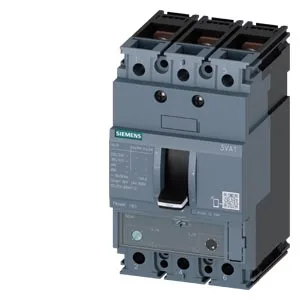
MCCB for line protection — 20 A, 3-pole, high interrupting capacity
Its TM240 thermal-magnetic release provides fixed overload and short-circuit protection without field-adjustable trip settings — a set-and-forget choice for standard feeder or branch circuits. Breaking capacity is the headline here: 220 kA at 240 VAC, 154 kA at 415 V, 121 kA at 440 V, and still 17 kA at 690 V. Current rating holds flat at 20 A from 40 °C through 55 °C, then derates to 19 A at 60 °C and 65 °C, and 19 A at 70 °C. That minimal derating across a 30 °C span means the breaker keeps its full rating in most ventilated enclosures; only above 55 °C do you lose 1 A.
The 76.2 mm (3 in) width is standard for a 3-pole MCCB in the SENTRON 3VA platform — it occupies three 25.4 mm pole spaces on a DIN rail or panel-mount base. Depth of 70 mm (2.76 in) leaves clearance for rear-connected busbars or cable lugs in a typical 400 mm deep enclosure. Maximum power loss is 12 W at rated current — a modest thermal load that won't drive significant enclosure derating in a ventilated panel, but worth noting for sealed or high-density layouts.
Auxiliary switching and signaling
A trip indicator is present on the breaker face for local visual confirmation.