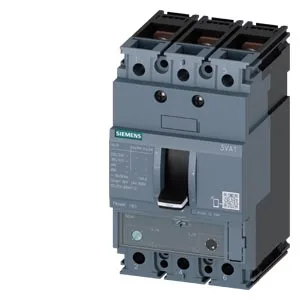
Its 220 kA breaking capacity at 240 V AC drops to 154 kA at 415 V and 121 kA at 440 V, then to 17 kA at 500 V and 690 V — the high short-circuit ratings at lower voltages make this breaker suited for high-fault service-entrance or sub-distribution positions where the available fault current exceeds what a standard 25/36 kA MCCB can handle. Thermal derating is minimal through 55 °C — the breaker holds 20 A at 40, 45, 50, and 55 °C (–) — then steps to 19 A at 60, 65, and 70 °C (–). This flat curve means the 20 A frame can be applied near its nameplate rating in warm enclosures without oversizing, a practical advantage for panel builders working to a 50 °C ambient design target.
Auxiliary complement and release configuration
The trip alarm switch (HQ) changes state only on a fault trip, not on manual open, giving the PLC or annunciator a dedicated signal for breaker trip events. The breaker includes a mechanical trip indicator for local visual confirmation of a trip condition. No ground-fault monitoring is fitted — this is a straight line-protection MCCB, not a GFPE device.
The 76.2 mm width is a standard 3-pole MCCB footprint for DIN-rail or panel-mount installation — it occupies the same horizontal space as other 3VA1 frame breakers, so a panel laid out for a 3VA1110 variant accepts this unit without re-drilling the mounting plate.