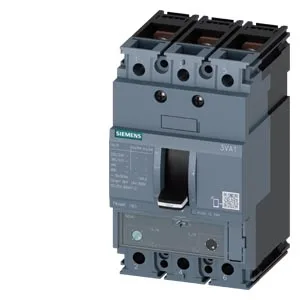
What this MCCB delivers — and where the ratings matter
The Siemens 3VA1120-6EF32-0CH0 is a 3-pole SENTRON molded case circuit breaker rated for line protection, carrying a continuous current Iu of 20 A and an insulation voltage Ui of 800 V. Its interrupting capacity at 240 V reaches 220 kA — that is the fault current it can safely clear without welding contacts or venting gas into the panel. At 415 V it still holds 154 kA, and at 690 V it drops to 17 kA; the so-what for the buyer is that this breaker is sized for high-fault installations at the lower distribution voltages common in North American and Asian 240/415 V networks, not for 690 V motor circuits.
Thermal derating and the real current you can run
The breaker holds its full 20 A from 40 °C up to 50 °C. At 55 °C it derates to 19.2 A, at 60 °C to 18.8 A, and at 70 °C to 18 A. If the panel ambient runs hot — say a sealed enclosure next to a furnace line — the 18 A at 70 °C figure is the one to design for, not the nameplate 20 A. The TM240 overcurrent release is fixed-thermal-magnetic, so no adjustment dial; the trip curve is set at the factory.
Auxiliary contacts and undervoltage release — what is wired in
This variant ships with 2 auxiliary switches plus 1 trip-alarm switch (the HQ configuration), and an undervoltage release (UVR) fitted as standard. The UVR trips the breaker when control voltage drops below its dropout threshold — common in safety circuits where loss of control power must open the main contacts. The integrated auxiliary trip is order code 3VA9608-0BB24, a separate accessory if you need to add remote shunt-trip capability later. There is no communication module, no ground-fault monitoring, and no phase-failure detection on this version.
Panel fit — dimensions and IP rating
The breaker measures 130 mm high, 76.2 mm wide, and 70 mm deep. That 76.2 mm width is three 25.4 mm pole modules — standard for a 3-pole MCCB on a DIN rail or panel-mount footprint. Front protection is IP40, meaning tools or fingers cannot reach live parts from the front, but the enclosure must keep out water and dust from other directions.
