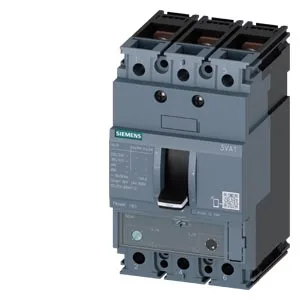
It carries a TM240 overcurrent release, a thermal-magnetic unit with a 240 A fixed magnetic trip threshold, and a continuous current rating of 20 A that holds steady from 40 °C up to 55 °C before it starts to derate at 60 °C. The 220 kA interrupting rating at 240 VAC is the headline figure — that's the short-circuit current it can safely clear at the lowest common industrial voltage. At 415 V it's still 154 kA, at 440 V it's 121 kA, and at 500 V and 690 V it drops to 17 kA. It's sized for high-fault locations where the available fault current would blow a standard 10 kA or 25 kA MCCB apart.
Undervoltage release and panel integration
This order code includes an undervoltage release (UVR) — the entry confirms it's an undervoltage release (UVR) design. If you're wiring a safety-rated panel or an emergency-stop chain that needs to kill the feeder on undervoltage, this UVR saves you an external relay. The breaker itself is 76.2 mm wide, 130 mm tall, and 70 mm deep — standard SENTRON 3VA footprint, so it'll drop into a DIN-rail or screw-mounted panel without re-drilling the backplate. Power dissipation maxes at 14.5 W, which is modest for a 20 A MCCB; no forced cooling needed in a standard panel.