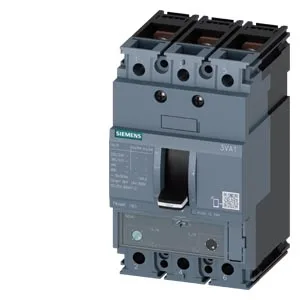
MCCB for high-fault panels
The Siemens SENTRON 3VA1120-6EF32-0DC0 is a 3-pole molded case circuit breaker (MCCB) rated for 20 A continuous current across its operating temperature range up to 55 °C, with a slight derating to 19 A at 60 °C and above. Its headline breaking capacity hits 220 kA at 240 V AC — that is the fault current it can safely interrupt without welding contacts or venting arc gas into the enclosure. At 415 V it still clears 154 kA, and at 690 V it holds 17 kA, which covers most industrial distribution panels downstream of a large transformer. This is a line-protection design (not a motor-protective or feeder breaker), so it is sized for cable and busbar protection in a main or sub-distribution board. The rated insulation voltage of 800 V gives headroom for 690 V systems without requiring series connection of poles.
Built-in undervoltage release and auxiliary contacts
The breaker ships with an undervoltage release (UVR) factory-installed — part of the order code suffix. That UVR trips the breaker when control voltage drops below a threshold, which is typical for emergency-stop circuits or mains-monitoring schemes where a loss of control power must open the main disconnect. It also carries two auxiliary switches (HQ design) for status feedback to a PLC or panel lamp. Maximum power loss is 14.5 W, which matters for thermal management inside a sealed enclosure. The operating temperature range is -25 °C to 70 °C, storage from -40 °C to 80 °C.
Physical fit and panel integration
Dimensions are 130 mm height, 76.2 mm width (3 inches), 70 mm depth. That 3-inch width is the standard 3-pole MCCB footprint for SENTRON 3VA — it occupies three 18 mm module spaces on a DIN rail or mounting plate. The depth of 70 mm leaves room behind a 200 mm deep enclosure for wiring and the UVR coil.
