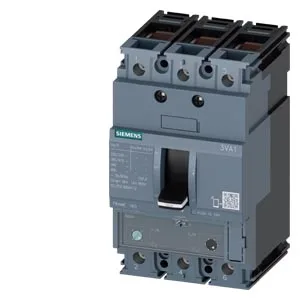
It is a 3-pole unit rated at 20 A continuous current across the 40 °C to 55 °C ambient range, derating to 19 A at 60–70 °C.
Breaking capacity — what the voltage-specific ratings mean for your fault level
This MCCB carries a 220 kA interrupting rating at 240 V, 154 kA at 415 V, 121 kA at 440 V, and 17 kA at both 500 V and 690 V. The steep drop above 440 V reflects the physics of arc extinction in air — at higher voltages the arc re-strikes more readily, so the breaker can only guarantee interruption at lower fault currents. For a 480 V panel (common in North America) the relevant figure is the 440 V rating of 121 kA, which is conservative for that voltage class. At 690 V the 17 kA rating still covers most industrial motor branch circuits, but verify your available fault current against that ceiling.
Auxiliary switching and integration
The breaker ships with 4 auxiliary switches HQ (high-rupturing-capacity changeover contacts) factory-fitted — no separate ordering or field assembly needed. These report open/closed status and trip indication to a PLC or status lamp. The 3VA1120-6EF36-0AE0 does not include an undervoltage release, shunt trip, or communication module; those are available as add-on accessories if the application requires remote tripping or energy monitoring.
Physical fit and panel considerations
Dimensions are 130 mm height, 76.2 mm width, 70 mm depth — a standard 3-pole MCCB footprint that mounts on a DIN rail or panel-mount adapter. Maximum power dissipation is 12 W at rated load, so ventilation in a sealed enclosure should account for that heat.