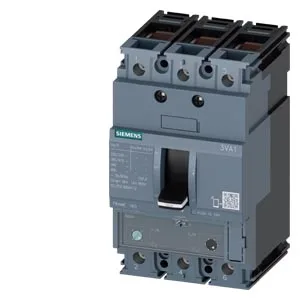
What this breaker is and what the ratings mean
The Siemens 3VA1120-6EF36-0DC0 is a SENTRON molded case circuit breaker (MCCB) designed for line protection — the primary role of this class is to protect cables and busbars from overcurrent and short-circuit faults in distribution panels. It is a 3-pole unit rated 20 A continuous at 40 °C, with a thermal derating curve that holds 20 A up to 55 °C and drops to 19 A at 60 °C and above — meaning in a warm enclosure you lose 1 A of headroom above 55 °C, a detail that matters for a panel builder sizing the breaker to a continuous load. The headline breaking capacity is 220 kA at 240 VAC, stepping down to 154 kA at 415 V, 121 kA at 440 V, and 17 kA at both 500 V and 690 V. That 220 kA figure at 240 V is exceptionally high — it tells you this breaker is sized for high-fault locations like a main service entrance or a transformer secondary where available fault current is severe. The rated insulation voltage is 800 V, so the internal clearances and creepage are designed for 690 V systems with margin. Maximum power loss is 14.5 W per pole — a panel designer working on a multi-breaker lineup should sum these losses when calculating enclosure ventilation. The breaker ships with an undervoltage release (UVR) and two auxiliary switches (HQ design), so it integrates directly into a safety circuit that needs to drop the main breaker on loss of control voltage.
Dimensions and panel fit
Width is 76.2 mm (3 in), depth 70 mm (2.76 in), height 130 mm (5.12 in). That 76.2 mm width is a standard 3-module MCCB footprint — it occupies three 25.4 mm positions on a DIN rail or panel-mount plate. For a panel OEM wireman, the 70 mm depth means it clears a standard 200 mm deep enclosure with room for rear wiring gutters.
What the auxiliary release and switches add
The undervoltage release (UVR) trips the breaker when control voltage drops below a threshold — standard for applications where loss of control power must open the main disconnect (e.g., emergency stop circuits, safety-rated machine isolation). The two HQ auxiliary switches provide status feedback (open/closed) to a PLC or indication lamp. No communication function is built in, so remote monitoring requires an external I/O module reading the aux contacts.
