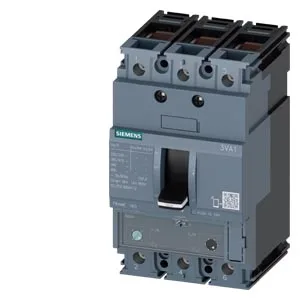
What this 20 A MCCB brings to a panel
The 220 kA breaking capacity at 240 V tells you this thing can clear a massive fault without venting the panel; at 415 V it still holds 154 kA, and at 690 V it drops to 17 kA. That's a high-interrupting rating for a 20 A frame — you're buying selectivity headroom. The TM240 release is the fixed thermal-magnetic type — no electronic adjustment, no communication module, no phase-failure detection. It's a dumb, reliable overcurrent trip. The shunt trip (STL) is integrated, so you can remote-trip it from a safety circuit or E-stop string. The 70 mm depth and 76.2 mm width fit the standard 3VA frame footprint; it'll drop into a panel already laid out for the SENTRON 3VA family without re-drilling the mounting plate.
Thermal derating — the real-world current you can actually run
At 55 °C it derates to 19.2 A, at 60 °C to 18.8 A, at 65 °C to 18.4 A, and at 70 °C to 18 A. That's a shallow derating curve — you lose only 2 A across a 30 °C rise. Compare that to a smaller-frame MCCB that might derate 20 % or more over the same span.
The 76.2 mm width (3-pole) matches the standard 3VA frame — it occupies three 25.4 mm module spaces on a DIN rail or bolted directly to a mounting plate. Depth is 70 mm from the mounting surface to the front of the handle, which leaves room for rear-access bus bars or a gland plate behind the breaker. The shunt trip coil is factory-installed; verify the control voltage matches your trip circuit before wiring. The auxiliary contacts are wired via the integrated terminal block on the front face — no need to open the arc chamber.