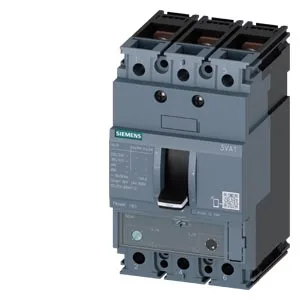
Its interrupting capacity hits 75.6 kA at 240 V and still holds 52.5 kA at 415 V — enough backbone for most commercial and light industrial service entrances where high fault current is a concern.
What the interrupting ratings mean on site
The 75.6 kA at 240 V and 52.5 kA at 415 V tell you this breaker clears a bolted fault at those levels without welding its contacts or venting arc gas into the enclosure. At 440 V it still manages 32 kA, and at 500 V or 690 V it holds 11.9 kA — that last figure matters if you're on a 690 V mining or pumping application. For a 25 A frame, those are high-interrupt numbers; you're buying headroom for a strong source side.
Built-in release and aux switch config
No communication module onboard, so it's a straight electromechanical breaker; you get the trip signal from the aux contacts, not over a bus.
Rated 25 A from 40 °C to 50 °C ambient, then it drops to 24 A at 55–60 °C and 23 A at 65–70 °C. That's a shallow derating curve — you lose only 2 A over a 30 °C rise — so it stays usable in a warm panel without oversizing. Power loss runs 11 W max at full load, which is manageable for thermal calculations inside a closed enclosure.