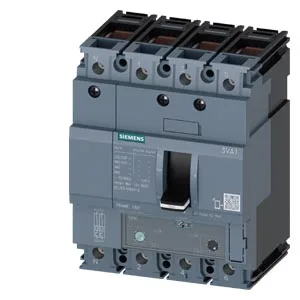
Rated current and breaking capacity — what they mean for panel coordination
The Siemens 3VA1125-3GF46-0AA0 is a SENTRON molded case circuit breaker (MCCB) rated for a continuous current of 25 A at 40 °C ambient, with the same 25 A rating holding through 50 °C before a mild derate begins at 55 °C (24 A) and 65 °C (23 A). That thermal profile means the breaker carries its full nameplate current in most ventilated enclosures without forced cooling — useful when the panel runs warm but stays below 50 °C. The interrupting capacity is specified at multiple system voltages: 75.6 kA at 240 V, 52.5 kA at 415 V, 32 kA at 440 V, and 11.9 kA at both 500 V and 690 V. For a 4-pole MCCB on a 415 V three-phase network, the 52.5 kA figure gives substantial fault-current headroom above typical utility fault levels, which simplifies selective coordination with downstream breakers.
TM240 release and line protection design
The overcurrent release is designated TM240 — a thermal-magnetic type with a fixed thermal pickup and magnetic trip calibrated for the 25 A frame.
Physical footprint: 130 mm height, 101.6 mm width, 70 mm depth. The 101.6 mm width (4 inches) is the standard 4-pole MCCB width in the SENTRON 3VA platform, matching the DIN-rail or mounting-plate cutout pattern used across the 3VA1 frame family. Depth of 70 mm (2.76 in) means it protrudes less from the mounting surface than older SENTRON or 3VF series breakers, which helps in shallow enclosures.