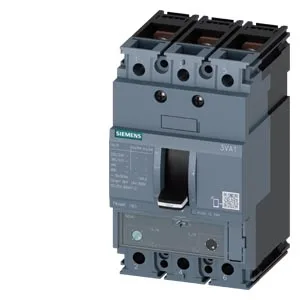
The Siemens SENTRON 3VA1125-4EF32-0AG0 is a 3-pole molded case circuit breaker (MCCB) rated for line protection at a continuous current of 25 A. It carries a TM240 thermal-magnetic overcurrent release, meaning the thermal element is fixed at 25 A and the magnetic trip is set at 240 A — a standard combination for motor branch circuits or feeder protection where high inrush must not nuisance-trip the thermal element. The interrupting ratings are substantial: 121 kA at 240 V and 75.6 kA at 415 V, which places it well above typical panel SCCR requirements for most industrial and commercial distribution boards. The 70 mm depth and 76.2 mm width fit the standard SENTRON 3VA footprint, so it drops into existing panel layouts without re-drilling the mounting plate. The front face carries IP40 protection — fine for a dry indoor enclosure, but not for washdown zones. A mechanical trip indicator is built in, and the auxiliary contact configuration includes one auxiliary switch plus one trip alarm switch, which is enough to signal status back to a PLC or annunciator panel without an add-on module.
Thermal derating and real-world current
The 25 A rating holds flat from 40 °C through 50 °C, then begins a gentle taper: 24 A at 55 °C, 23.5 A at 60 °C, 23 A at 65 °C, and 22.5 A at 70 °C. That means in a crowded panel with ambient temperatures near 60 °C, you lose only 1.5 A of headroom — the breaker still carries a 23.5 A continuous load without tripping. The operating range spans -25 °C to 70 °C, with storage from -40 °C to 80 °C, so it handles seasonal temperature swings in unheated enclosures.
Panel fit and integration
The 76.2 mm width (three 25.4 mm pole pitches) matches the standard 3VA mounting pattern. Depth of 70 mm leaves clearance for rear-connected busbars or cable ducts in a 200 mm deep enclosure. The TM240 release is non-adjustable on the thermal side — the 25 A continuous rating is fixed — but the magnetic trip threshold is factory-set at 240 A, which suits motor starting currents up to about 9.6× FLA on a 25 A motor. No communication module, no undervoltage release, no ground-fault monitoring on this variant; it is a straight thermal-magnetic breaker for basic overcurrent and short-circuit protection.
