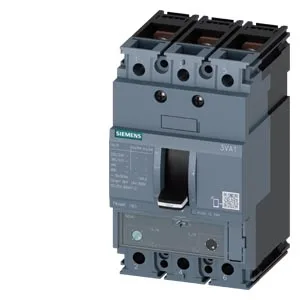
What this MCCB is and what it carries
The Siemens SENTRON 3VA1125-4EF32-0AH0 is a 3-pole molded case circuit breaker (MCCB) rated for 25 A continuous current with a TM240 thermal-magnetic release. It's a line-protection device, not a motor-protective or ground-fault version — no undervoltage release, no phase-failure detection, no communication module onboard. The TM240 release means the thermal element is fixed at 240 A short-circuit pickup; the magnetic instantaneous trip is factory-set and non-adjustable. For a panel-builder, that's a clean fit where you need a straight feeder breaker with no auxiliary logic.
Breaking capacity — what the numbers mean across voltages
This MCCB delivers 121 kA at 240 V, 75.6 kA at 415 V, 52.5 kA at 440 V, and 11.9 kA at 690 V. Those are the interrupting ratings at each voltage level — the breaker can safely clear a fault up to those prospective short-circuit currents. At 690 V the 11.9 kA figure is lower than some larger-frame SENTRON siblings, so verify your available fault current at that voltage if you're feeding a 690 V bus. At 415 V, the 75.6 kA rating covers most industrial distribution panels without needing a current-limiting upstream device.
Thermal derating — continuous current across ambient temperature
The breaker holds 25 A continuously from 40 °C up to 50 °C. Above that it derates: 24 A at 55 °C, 23.5 A at 60 °C, 23 A at 65 °C, and 22.5 A at 70 °C. That's a shallow derating curve — you lose only 2.5 A over a 30 °C rise. For a panel running warm (say 55 °C near the top of a sealed enclosure), you still get 24 A of headroom. The rated insulation voltage is 800 V, and the operating range is -25 °C to 70 °C, with storage from -40 °C to 80 °C.
Physical fit and auxiliary contacts
Dimensions are 70 mm deep, 76.2 mm wide, and 130 mm high. That 76.2 mm width is a standard 3-pole MCCB footprint — it fits the same DIN-rail or screw-mount pattern as other SENTRON 3VA frames. The auxiliary contact version fitted is 2 auxiliary switches plus 1 trip alarm switch (HQ designation). That gives you two form-C signals for status feedback and a dedicated alarm contact that changes state only on a trip event, not on manual switching. The front face carries IP40 protection — fine for a panel interior, not for washdown exposure.
