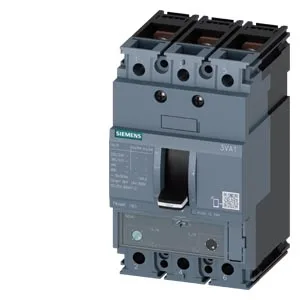
What the 121 kA interrupting rating means for your panel
Its interrupting capacity reaches 121 kA at 240 V, 75.6 kA at 415 V, 52.5 kA at 440 V, and 11.9 kA at 690 V — that SCCR headroom means it can safely clear a bolted fault on a high-capacity transformer secondary without upstream fuses having to open first. The thermal-magnetic release is a TM240, so the thermal curve is fixed and non-interchangeable; the magnetic pickup is factory-set to the 240 A range. This is a fixed-thermal, non-communicating breaker — no trip indicator, no phase-failure detection, no communication module.
Thermal derating and ambient temperature profile
Above that, it derates linearly: 24 A at 55 °C, 23.5 A at 60 °C, 23 A at 65 °C, and 22.5 A at 70 °C. That's a 10 % reduction from 25 A to 22.5 A across the 50–70 °C band — tight enough that a panel designer can size for 25 A and still have margin at the high end of a NEMA 12 enclosure.
The 3VA1125-4EF32-0DC0 measures 70 mm deep, 76.2 mm wide, and 130 mm high. The undervoltage release and the two auxiliary switches (HQ) add depth behind the breaker; verify clearance for the wiring of those terminals.
Coordination and selectivity notes
Because the TM240 release has a fixed thermal curve, selectivity with downstream miniature circuit breakers (MCBs) depends on the MCB's instantaneous trip threshold. The 3VA1125's magnetic pickup is at 240 A (10x Iu), so a downstream 16 A MCB with a B-curve (instantaneous at 3–5x In) will trip before the MCCB on a low-level fault. For full selectivity up to the MCCB's instantaneous threshold, pair it with a downstream breaker whose let-through energy (I²t) is below the MCCB's magnetic trip level. The 15 000 latching endurance cycles mean it's rated for infrequent switching — it's a protection device, not a load-break switch.