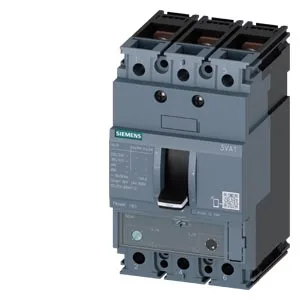
The breaking capacity is 121 kA at 240 V AC, dropping to 75.6 kA at 415 V and 52.5 kA at 440 V — figures that give solid fault-clearing headroom for most low-voltage commercial and light industrial installations. At 690 V it still interrupts 11.9 kA, covering 690 V line-to-line systems where available. The maximum power loss is 8.5 W, a figure to factor into enclosure thermal calculations when grouping several breakers.
The 25 A rating holds across 40 °C to 50 °C ambient without derating — at 55 °C it drops to 24 A, at 65 °C to 23 A, and at 70 °C still 23 A. That gives remote tripping capability and status feedback — useful for emergency-stop circuits or PLC-based monitoring where the breaker position needs to be known in the control system. A trip indicator and voltage trigger are present, so the breaker provides local visual indication of a trip event.
That covers most indoor and sheltered outdoor installations, though the lower operating limit means it should not be relied upon for switching at sub-freezing temperatures without verifying the mechanism's performance. Dimensions are 130 mm height, 76.2 mm width, 70 mm depth — a compact footprint that fits standard Siemens 3VA panel cutouts and busbar systems. The width is exactly 3 inches (76.2 mm), which matches the typical 3-pole MCCB mounting pitch in most distribution boards.