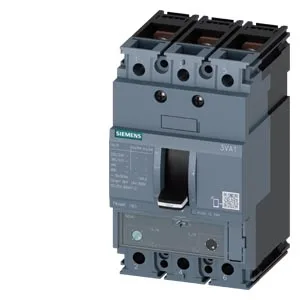
The Siemens SENTRON 3VA1125-5EF32-0AE0 is a 3-pole molded case circuit breaker (MCCB) rated for line protection, carrying a 25 A continuous current at 40 °C and a TM240 thermal-magnetic overcurrent release. Its interrupting capacity hits 187 kA at 240 V, 121 kA at 415 V, and 75.6 kA at 440 V — numbers that tell you it handles high-fault utility feeds and large transformer secondaries without cascading upstream.
Breaking capacity and current derating
At 415 V it still clears 121 kA; at 440 V it drops to 75.6 kA; at 690 V it's 17 kA. The 25 A rating holds flat from 40 °C through 50 °C, then derates to 24 A at 55 °C, 23.5 A at 60 °C, 23 A at 65 °C, and 22.5 A at 70 °C — so in a hot enclosure or near other heat sources, plan the load at the derated value, not the nameplate.
The 3VA frame measures 76.2 mm wide, 130 mm tall, and 70 mm deep. The 4 auxiliary switches (HQ type) ride on the side, adding about one module width. Plan the enclosure depth to clear the 70 mm body plus wiring space behind the line/load lugs.
Release and accessory configuration
The auxiliary contact version ships with 4 HQ (high-utilization) switches. If your application needs a shunt trip, UVR, or communication, this variant does not carry them; you'd step to a different suffix in the 3VA family. The trip indicator is absent, so there's no local mechanical flag showing the breaker tripped on fault.