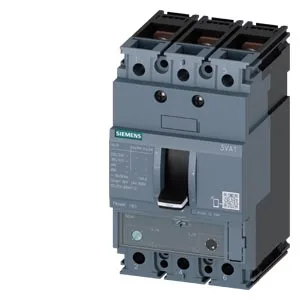
What this 3-pole MCCB carries — the ratings that decide fit
Its headline interrupting capacity hits 187 kA at 240 V, 121 kA at 415 V, 75.6 kA at 440 V, and 17 kA at 690 V — the 240 V figure is the one that governs fault-clearing duty on low-voltage mains, while the 690 V rating confirms it handles industrial 600 V class systems where available fault current stays under 17 kA. Rated continuous current Iu is 25 A, flat from 40 °C to 50 °C, then derated stepwise: 24 A at 55 °C, 23.5 A at 60 °C, 23 A at 65 °C, 22.5 A at 70 °C. That thermal curve means an enclosure at 50 °C ambient still carries the full 25 A; push past 55 °C and you lose about 1 A per 5 °C rise. That tells you this is a straight line-protection breaker for fixed loads, not a variable-trip feeder.
The 3VA1125-5EF32-0CH0 measures 130 mm high, 76.2 mm wide, 70 mm deep. That 76.2 mm width is a standard 3-pole MCCB footprint — three module-widths at roughly 25.4 mm per pole. It mounts to a DIN rail or direct-panel screw pattern typical of the SENTRON 3VA platform. Verify the screw-terminal torque spec from the device manual before torquing to busbar or cable lugs.
Traceability and documentation
The auxiliary trip module specified for this unit is 3VA9608-0BB24 — that is the factory-matched undervoltage release module. The device manual (linked from Siemens Service & Support) covers DC network application notes if you are switching power values in DC circuits. For compliance documentation, Siemens provides RoHS and REACH declarations for the SENTRON 3VA series; UL and IEC listings are standard for MCCBs of this class — verify the specific UL file number against the nameplate on arrival.