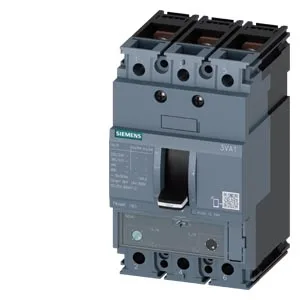
Breaking capacity — what it means for panel coordination
The 3VA1125-5EF32-0DA0: The 187 kA at 240 V is the maximum fault current this MCCB can safely interrupt without welding contacts or rupturing the case. In practice that SCCR lets you place it downstream of a transformer rated up to roughly 1500 kVA at 240 V secondary without needing a current-limiting fuse upstream. At 415 V the 121 kA still covers most industrial main switchboards. The 17 kA at 690 V is the ceiling for 690 V drives or generator feeds — still enough for typical 690 V distribution.
Thermal-magnetic release and derating curve
TM240 release means the thermal element is calibrated for a 25 A continuous load at 40 °C ambient. The current rating holds flat at 25 A from 40 °C to 50 °C, then drops to 24 A at 55–60 °C, and 23 A at 65–70 °C. If your panel ambient runs above 50 °C, factor that 1 A derate step — the breaker will still hold the line, but you lose a couple amps of headroom on the branch circuit.
Undervoltage release and line protection design
The built-in undervoltage release (UVR) trips the breaker when supply voltage drops below a set threshold — standard for safety circuits that need to drop power on loss of control voltage. The product design is explicitly line protection, not motor protection, so the TM240 curve is sized for cable and busbar protection, not motor thermal overload. If you are replacing a motor-circuit protector, check the trip curve against your motor's locked-rotor time.
Physical fit — DIN-rail and panel layout
Width 76.2 mm (3 inches), depth 70 mm, height 130 mm. Three-pole MCCB in this footprint mounts on a standard DIN rail or panel-mount plate.
