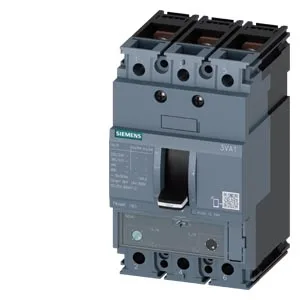
The TM240 designation indicates the thermal pickup is calibrated for a 25 A frame at 40 °C ambient, with the magnetic trip threshold set at 240 A — a fixed, non-adjustable value that suits branch circuits feeding motor starters or resistive loads where the inrush is known.
Breaking capacity — the number that decides selectivity
The interrupting rating is the single most important spec for a sourcing decision on an MCCB because it determines whether the breaker can clear a fault without failing catastrophically, and whether it coordinates with upstream devices. At 240 V, this 3VA1125-5EF32-0JA0 is rated for 187 kA; at 415 V it drops to 121 kA; at 440 V it is 75.6 kA; and at 500 V and 690 V it holds at 17 kA. The steep derating above 440 V is typical for a compact-frame MCCB — the arc-extinction chamber has less volume to stretch and cool the arc at higher voltages. For a 480 V panel in North America, the 75.6 kA at 440 V is the closest published value; for a 690 V wind-turbine or mining application, the 17 kA figure governs.
Rated 25 A from 40 °C through 50 °C ambient, the TM240 release begins to derate above 50 °C: 24 A at 55 °C and 60 °C, 23 A at 65 °C and 70 °C. Maximum power loss is 8.5 W — a modest figure that helps with thermal budgeting inside a crowded panel, but still worth checking against the enclosure's dissipation capacity if multiple breakers are ganged.
The 3VA1125-5EF32-0JA0 measures 130 mm high, 76.2 mm wide, and 70 mm deep. The width of 76.2 mm (3 inches) is the standard 3-pole MCCB footprint for the SENTRON 3VA1 frame — it occupies three 25.4 mm module positions on a DIN rail or bolts directly to a mounting plate.