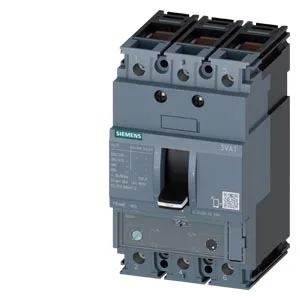
What this MCCB is and what it does
Siemens SENTRON 3VA1125-5EF36-0JH0 is a 3-pole molded case circuit breaker (MCCB) for line protection, rated 25 A continuous current (Iu) with a TM240 thermal-magnetic overcurrent release. The 187 kA breaking capacity at 240 V tells you this thing handles serious fault current — it's built for high-fault panels where a standard MCB would weld shut. At 415 V it still breaks 121 kA, and at 690 V it holds 17 kA, so it's sized for industrial distribution downstream of a transformer or a big UPS feed. The TM240 release means the thermal element tracks load heating and the magnetic trip snaps at a fixed multiple of 25 A — no electronic adjustment, just reliable bimetal-and-solenoid action. That's the right call for a line-protection MCCB where you want predictable coordination with downstream breakers. It ships with a shunt trip (STL) release built in, plus 2 auxiliary switches and 1 trip alarm switch (HQ version) — so you can remote-trip it from an E-stop or PLC and get status back to the control system without adding external relays.
Sizing and thermal derating — the real-world current
Rated 25 A continuous at 40 °C ambient, and it holds that same 25 A all the way to 50 °C. At 55 °C it derates to 24 A, at 60 °C to 23.5 A, at 65 °C to 23 A, and at 70 °C to 22.5 A. That's a shallow derating curve — you don't lose much headroom in a hot panel. The rated insulation voltage is 800 V, so it's comfortable on 480 V or 600 V class systems. Operating temperature range is -25 °C to 70 °C; storage range is -40 °C to 80 °C. Front protection is IP40 — fine for a clean indoor panel, but keep it out of washdown zones.
Panel fit and integration
Dimensions are 130 mm high, 76.2 mm wide, 70 mm deep — a standard 3-pole MCCB footprint that drops into most DIN-rail or panel-mount assemblies without re-drilling. The 76.2 mm width (3 inches) matches the typical 25 mm per pole spacing for busbar take-offs. Endurance rated at 15,000 mechanical operations — that's a solid number for a distribution breaker that sees occasional switching, not daily motor starts. No undervoltage release, no ground-fault monitoring, no communication module on this variant — it's a straightforward line-protection MCCB with shunt trip and auxiliary contacts.
