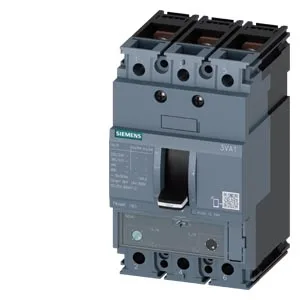
What the breaking capacity numbers mean for your panel
Its headline feature is the interrupting capacity: 220 kA at 240 V, 154 kA at 415 V, 121 kA at 440 V, and 17 kA at 690 V. That 220 kA at 240 V means this breaker can safely clear a fault current up to 220,000 amps without welding its contacts or rupturing the case — critical for high-fault locations like transformer secondaries or large motor control centers where available fault current can exceed 100 kA. The 17 kA at 690 V tells you it's still usable on 690 V systems, but the fault-current ceiling drops sharply; don't spec it for a 690 V bus with more than 17 kA available.
Thermal derating — don't cook it
Above that, it derates: 24 A at 55 °C, 23.5 A at 60 °C, 23 A at 65 °C, and 22.5 A at 70 °C. Plan your load accordingly; don't crowd the breaker next to a heat source inside the cabinet.
Built-in undervoltage release and auxiliary contacts
That's useful for preventing automatic restart after a brownout or for safety circuits that need to drop the load on loss of control power. The integrated auxiliary trip is order code 3VA9608-0BB25 if you need a replacement.
No trip indicator or voltage trigger on this variant; you'll need the auxiliary switch feedback to know its state remotely.