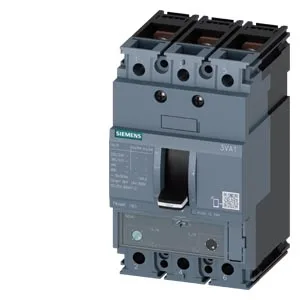
What this MCCB carries — and what it doesn't
The Siemens 3VA1125-6EF32-0HC0 is a 3-pole SENTRON molded case circuit breaker rated for 25 A continuous current (Iu) with a TM240 thermal-magnetic overcurrent release. It's built for line protection — meaning it guards the feeder or downstream distribution, not a motor or a branch with special coordination needs. The breaking capacity is what sets this part apart: 220 kA at 240 V, 154 kA at 415 V, 121 kA at 440 V, and still 17 kA at 690 V. That high-interrupting rating means it can clear a fault without upstream fuses or a bigger breaker taking the hit — useful when you're feeding a panel off a high-capacity transformer or a utility service with stiff fault current. This version ships with a shunt trip (STL) auxiliary release (order code 3VA9688-0BL30 for the integrated auxiliary trip) and two HQ auxiliary switches. No undervoltage release, no ground-fault monitoring, no communication module, no phase-failure detection — it's a straightforward overcurrent-only device with remote-trip capability. If your BOM calls for undervoltage protection or ground-fault sensing, this isn't the variant.
Thermal derating — where the 25 A holds and where it doesn't
The 25 A rating is valid from 40 °C through 50 °C ambient. At 55 °C it derates to 24 A, at 60 °C to 23.5 A, at 65 °C to 23 A, and at 70 °C to 22.5 A. If your panel sits in a hot enclosure — say a non-ventilated steel box in a mill or a sunny outdoor cabinet — that derating curve is the one that governs the actual load you can hang on this breaker. The TM240 release is factory-set; no field adjustment of the thermal element.
Physical fit and panel integration
The 3VA1125-6EF32-0HC0 measures 70 mm deep, 76.2 mm wide, and 130 mm tall. That's a standard 3-pole MCCB footprint — it fits the same DIN-rail or screw-mount pattern as other 3VA frame breakers. Front protection is IP40, so it's fine inside a clean panel but not for washdown or outdoor exposure without an enclosure. No trip indicator on the front face; you'll know it's tripped by the handle position or the auxiliary switch feedback.
