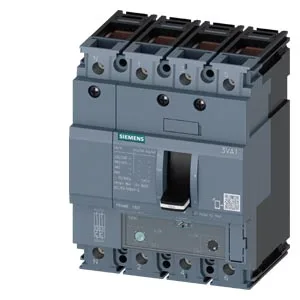
What the 25 A rating and breaking capacities mean for your panel
At 240 V it interrupts faults up to 220 kA; at 415 V that figure drops to 154 kA, at 440 V to 121 kA, and at 500 V and 690 V it holds at 17 kA. Thermal performance is stable across the panel ambient range: the breaker carries a full 25 A from 40 °C through 50 °C, then derates to 24 A at 55–60 °C, and 23 A at 65–70 °C. That means in a crowded enclosure running hot, you lose only about 8 % of the rating — still within typical design margins for a 25 A feeder. The TM240 overcurrent release is a fixed thermal-magnetic type — no interchangeable trip units, no adjustable settings. It is a straight line-protection device for fixed-load feeders where coordination studies are already locked in. If you need adjustable LSIG or a shunt trip, this is not the variant.
That 4-inch width is standard for a 4-pole MCCB in the SENTRON 3VA platform — it will occupy the same DIN-rail or mounting-plate footprint as other 4-pole 3VA frames. If you are swapping into an existing panel that was laid out for a 3VA1110-5ED36-0AA0 (a 4-pole 100 A frame), the physical envelope is identical; the difference is the trip rating and the breaking capacity curve. No rewiring needed at the line/load terminals if the lug sizes match.
Maximum power loss is 8.5 W.