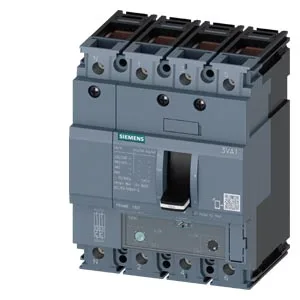
Its breaking capacity varies with system voltage — 220 kA at 240 V AC, 154 kA at 415 V, 121 kA at 440 V, and 17 kA at 500 V or 690 V — so the actual fault-clearing capability depends on your supply voltage.
At 240 V the breaker interrupts up to 220 kA — that's a very high interrupting rating, typical for a main or large feeder breaker in a high-fault industrial panel. Above 500 V the rating settles at 17 kA, which still covers most downstream branch circuits. The thermal rating holds full 25 A up to 50 °C ambient (–); at 55 °C and 60 °C it derates to 24 A, and at 65–70 °C it runs at 23 A. That derating curve means you can mount it in a warm enclosure without losing much capacity.
Built-in auxiliary and release options
That means you get remote status indication (open/closed/tripped) plus a remote trip capability — useful for emergency-stop circuits or load-shedding schemes.