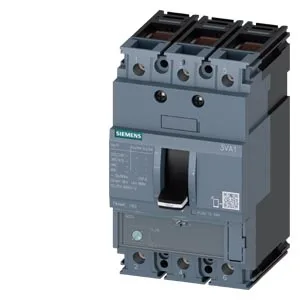
SCCR and selectivity — what the ratings mean for your distribution board
The 3VA1132-5EE36-0AB0 is a Siemens SENTRON molded case circuit breaker (MCCB) rated for 125 A continuous current (Iu) at 40 °C, with a TM240 thermal-magnetic overcurrent release. Its interrupting capacity is the headline figure for panel builders coordinating fault levels: 187 kA at 240 VAC, 121 kA at 415 VAC, 76 kA at 440 VAC, and 17 kA at both 500 VAC and 690 VAC. These are the maximum short-circuit currents the breaker can safely clear without welding contacts or rupturing the arc chamber — critical for selectivity studies where upstream breakers must see the fault and stay closed. The 4-pole construction handles three-phase plus neutral (or switched neutral) in a single enclosure, saving a pole space versus separate breakers.
Derating and thermal limits — the real-world current rating
The 125 A rating holds flat from 40 °C to 50 °C ambient, then steps down: 122 A at 55 °C, 120 A at 60 °C, 117 A at 65 °C, and 114 A at 70 °C. For a panel OEM packing breakers into a confined enclosure, this derating curve governs the actual load you can protect — if the internal panel ambient hits 60 °C, you lose 5 A of headroom. The TM240 release is a fixed thermal-magnetic type; no electronic adjustment or communication module is fitted. The front face carries IP40 protection, meaning tools or fingers won't contact live parts, but the breaker is not sealed against water ingress — mount it inside a rated enclosure in washdown areas.
Physical fit and panel integration
The breaker measures 130 mm in height and 4 inches in width — a standard MCCB footprint that drops into most SENTRON panelboards and DIN-rail adapter plates without re-drilling. Latching endurance is rated at 15,000 operations, which covers frequent switching in machine-tool or conveyor applications. Storage temperature range spans -40 °C to 80 °C, so the part can sit in an unheated warehouse or shipping container without damage.
