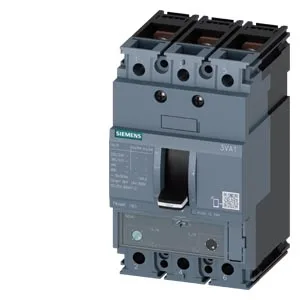
What this MCCB delivers
The Siemens 3VA1132-6EF32-0AD0 is a SENTRON 3VA1 molded case circuit breaker (MCCB) rated for line protection in three-phase distribution. It carries a rated continuous current Iu of 32 A and a rated insulation voltage Ui of 800 V, with a TM240 thermal-magnetic overcurrent release — no undervoltage release, no ground-fault monitoring, no communication function. The breaking capacity at 240 V is 220 kA, at 415 V it's 154 kA, at 440 V it's 121 kA, and at 690 V it's 17 kA. Those numbers tell you this breaker is built for high-fault-current panels where the available short-circuit current at the main lug is substantial — think transformer secondaries or large motor-control centers. The 32 A rating holds steady up to 50 °C ambient; at 55 °C it derates to 30.72 A, at 60 °C to 30.08 A, at 65 °C to 29.44 A, and at 70 °C to 28.8 A. The front face carries IP40 protection, so it's fine inside a clean panel but not for washdown areas.
Panel fit and integration
The 3VA1132-6EF32-0AD0 measures 130 mm high, 76.2 mm wide, and 70 mm deep — a standard 3-pole MCCB footprint for DIN-rail or screw-mount panel integration. It ships with three auxiliary switches (HQ type) fitted; no additional auxiliary release is installed. The latching endurance is rated at 15,000 operations, which is typical for a distribution breaker that sees infrequent switching. Operating temperature range is -25 °C to 70 °C; storage range is -40 °C to 80 °C.
What the ratings mean for your panel
The 220 kA breaking capacity at 240 V is the headline number — it means this breaker can safely interrupt a fault current up to that level without welding contacts or rupturing the case, which is critical for main-service or high-fault locations. At 415 V (common in industrial 400 VAC systems) the rating is still 154 kA, and at 440 V it's 121 kA. The 690 V rating drops to 17 kA, so if you're feeding a 690 V motor drive, verify the available fault current at that voltage against the 17 kA limit. The TM240 release is thermal-magnetic — the thermal element handles overloads (inverse time), the magnetic element handles short-circuits (instantaneous). The adjustable response time tr max is 1 second, which gives some coordination flexibility downstream. No voltage trigger, no phase-failure detection, no ground-fault monitoring — this is a basic line-protection breaker, not a multifunction device.
