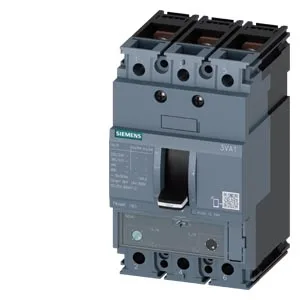
What this MCCB carries — and where it fits
The Siemens 3VA1132-6EF32-0AF0 is a SENTRON molded case circuit breaker (MCCB) rated 32 A continuous at 40 °C with a TM240 thermal-magnetic release — line-protection design, not motor-protection. Three poles, 800 V rated insulation voltage, and a breaking capacity that hits 220 kA at 240 V AC. That 220 kA figure is the headline: it handles very high available fault current at the service entrance or main distribution panel without needing a current-limiting fuse upstream. The 32 A rating holds steady from 40 °C to 50 °C, then derates to 30 A at 65–70 °C. Operating temperature range is -25 °C to 70 °C. Dimensions are 130 mm high, 76.2 mm wide, 70 mm deep — mounts on a DIN rail or panel-mount baseplate in a standard distribution board. Built-in auxiliary switch configuration: one auxiliary switch plus one trip alarm switch (HQ type). No undervoltage release, no ground-fault monitoring, no communication module. This is a clean line-protection MCCB — spec it where you need high interrupting capacity and a simple thermal-magnetic trip curve, not where you need remote trip signalling or earth-leakage detection.
Breaking capacity — the so-what for the panel
At 240 V the 3VA1132-6EF32-0AF0 clears 220 kA. At 415 V it's still 154 kA; at 440 V, 121 kA. At 500 V and 690 V the rating drops to 17 kA — still respectable for most industrial loads, but not the same class as the low-voltage figures. The steep drop-off above 480 V means this breaker is primarily sized for 240 V or 400/415 V distribution where fault currents are high. For a 690 V wind-turbine auxiliary panel the 17 kA SCCR may be tight — verify the available fault current at the point of installation.
Integration notes for the panel builder
The 3VA1132-6EF32-0AF0 ships with a TM240 release — thermal-magnetic, fixed thermal rating at 32 A, magnetic trip set at the factory. No field-adjustable thermal dial. The auxiliary switch block (1 HQ + 1 trip alarm) is fitted at the factory; no field-installation of the switch block required. Panel builders should account for the 70 mm depth when routing busbars behind the breaker — shallower than many MCCBs of this class, which helps in compact enclosures. Power loss at rated current is 10.6 W maximum — negligible for thermal budgeting in a standard enclosure, but worth noting if the panel is densely packed and sealed (IP65 or higher). Storage temperature range is -40 °C to 80 °C, so the breaker can sit in an unheated warehouse or a nacelle awaiting install without issue.
